
I recently read something that stopped me in my tracks.
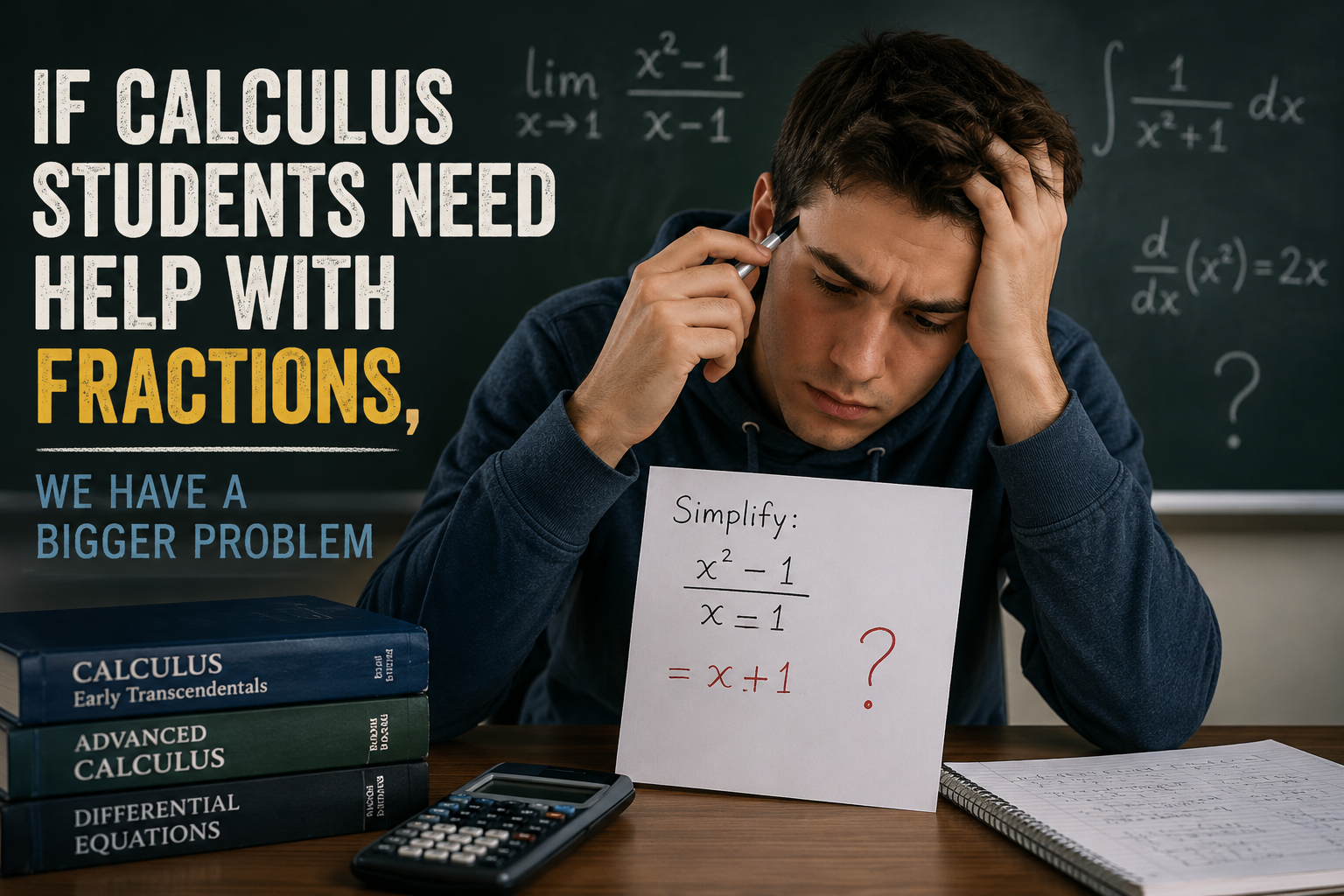
A UC Berkeley math professor says some students entering calculus are struggling with fractions and basic algebra.
Think about that.
We’re not talking about derivatives or integrals.
We’re talking about fractions. At UC Berkeley. In calculus.
It’s easy to blame students, but I think the problem is much bigger.
As someone who works with students preparing for the SAT and ACT, I see an educational system that has increasingly confused passing a class with mastering the material.
A student can earn an A or B in Algebra II, move to Precalculus, and still have significant gaps.
But math builds on itself.
Weak fractions become weak algebra. Weak algebra becomes difficulty in precalculus. Eventually those gaps show up in calculus.
COVID certainly didn’t help. Students lost instructional time, schools struggled with remote learning, and many students advanced with gaps that were never completely repaired.
This is also why standardized testing still matters.
For years, we heard that high school grades could tell colleges what they needed to know.
But what does an A mean if academic standards vary significantly between schools?
The SAT and ACT aren’t perfect.
But they provide another independent measurement that can reveal something a transcript doesn’t.
And I think that’s one reason we’re seeing universities reconsider test-optional admissions.
Access isn’t the same as preparedness.
I absolutely support giving more students access to advanced courses and great universities.
But lowering barriers without ensuring students have the foundation to succeed can simply move the struggle further down the road.
Students shouldn’t discover during freshman calculus that they’re several years behind in math.
We should identify those gaps much earlier.
Parents, ask another question.
Don’t just ask:
“What grade did you get?”
Also ask:
“What can you actually do?”
Can your student comfortably work with fractions, percentages, ratios, exponents, and algebra?
Can they explain why an answer makes sense?
Those questions may tell you more about college readiness than another A on a report card.
The answer isn’t simply making school or college admissions harder.
We need higher expectations AND better support.
Identify gaps earlier. Teach the fundamentals. Give students opportunities to catch up.
And we need to become comfortable telling a student:
“You’re not ready for the next level yet. Let’s get you ready.”
There is nothing wrong with needing more time to learn something.
But continually moving students forward without mastery eventually catches up with them.
If professors at one of America’s leading universities are reviewing fractions with calculus students, we should stop debating whether there’s a problem.
We should start talking about how we’re going to fix it.