
If college admissions feels confusing, you’re not alone. After decades helping families, I can tell you this: admissions rewards clarity and consistency, not chaos.
Good news—most problems are preventable. Here are the biggest mistakes I see parents make, and exactly what to do instead.
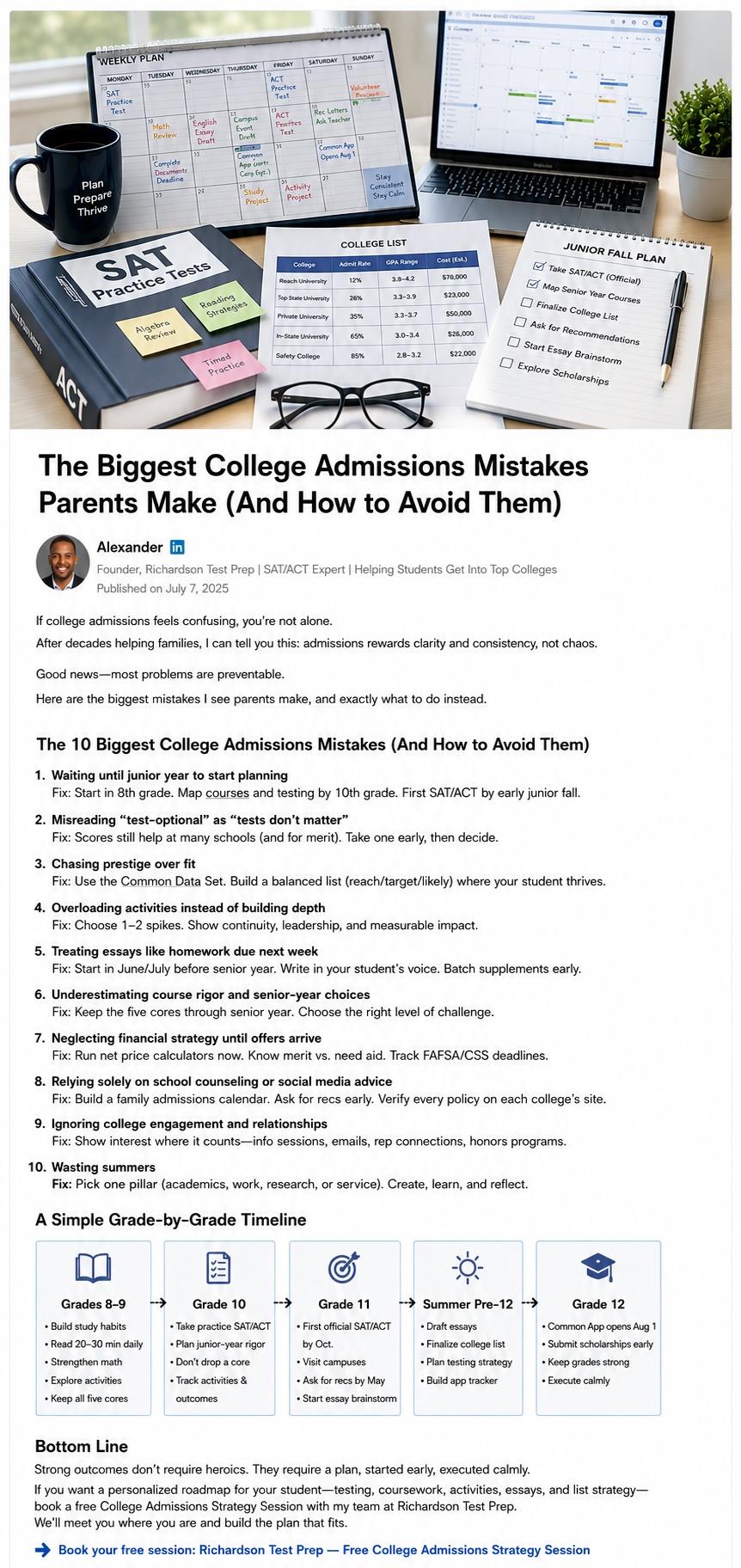
Mistake 1: Waiting until junior year to start planning What happens: Stress spikes, choices narrow, and rushed decisions lead to weaker outcomes. Do this instead:
- Grade 8–9: Build strong study habits, math readiness, and reading stamina. Keep all five core subjects (English, math, science, social studies, language).
- Grade 10: Baseline test (practice SAT/ACT), map course rigor, light skill-building.
- Grade 11: First official SAT/ACT by early fall; aim to finish testing by early spring.
- Grade 12: Execute the plan—no scrambling.
Mistake 2: Misreading “test-optional” as “tests don’t matter” What happens: Students miss out on admissions boosts and merit aid where scores still help. Do this instead:
- Assume scores are a positive signal unless a college truly doesn’t consider them.
- Take one official SAT or ACT early junior year, then decide: submit or go test-optional by college.
- Know each school’s policy (superscore, score choice) and merit aid criteria.
Mistake 3: Chasing prestige over fit What happens: Burnout, thin results, and unhappy transfers. Do this instead:
- Build a balanced list across admit-rate bands (reach/target/likely) using each school’s Common Data Set.
- Prioritize major strength, academic support, internships, and outcomes.
- Visit (or do virtual info sessions) with a clear rubric: academics, culture, advising, cost.
Mistake 4: Overloading activities instead of building depth What happens: A long resume with no real impact. Do this instead:
- Choose 1–2 “spikes” to pursue deeply (research, music, entrepreneurship, service with measurable outcomes).
- Track results: roles, hours, outcomes, artifacts (links, portfolios, awards).
- Work counts. So does caring for siblings. Own it—add scope and results.
Mistake 5: Treating essays like English homework due next week What happens: Generic essays, adult-sounding prose, and missed supplements. Do this instead:
- Start your personal statement in June/July before senior year; build a story bank of 10–12 moments.
- Write like you talk; revise with feedback, not rewrites.
- Calendar every supplemental essay by due date; batch by prompt type (Why Us, Why Major, Community, Activity).
Mistake 6: Underestimating course rigor and senior-year choices What happens: GPA looks fine but transcript lacks challenge or continuity. Do this instead:
- Keep the five cores through senior year; don’t drop a language or math early.
- For STEM, aim for calculus if appropriate; for humanities, maintain AP/IB/A-level rigor where ready.
- Prioritize an A in the right rigor over an overloaded schedule.
Mistake 7: Neglecting financial strategy until offers arrive What happens: Acceptance without affordability. Do this instead:
- Run each school’s net price calculator early; know need-based vs. merit aid.
- Track FAFSA/CSS deadlines; organize tax documents in advance.
- Target colleges where your student is top quartile—merit aid lives there.
Mistake 8: Relying solely on school counseling or social media advice What happens: Missed deadlines, myths, and one-size-fits-none guidance. Do this instead:
- Build a family admissions calendar with all testing, visits, rec requests, and app deadlines.
- Ask teachers for recommendations by late spring of junior year. Provide a short brag sheet with specifics.
- Verify every policy on each college’s site and Common Data Set.
Mistake 9: Ignoring college engagement and relationships What happens: You look indistinguishable from thousands of apps. Do this instead:
- Where “demonstrated interest” counts, attend info sessions, open emails, and connect with regional reps.
- Consider honors programs—often smaller classes and bigger merit dollars.
Mistake 10: Wasting summers What happens: Lost momentum and missed growth. Do this instead:
- Pick one pillar each summer: academics (community college course), work (paid job), research/creation (build something), or service (measurable project).
- Reflect in a short write-up—what you did, learned, and produced. That fuels essays.