
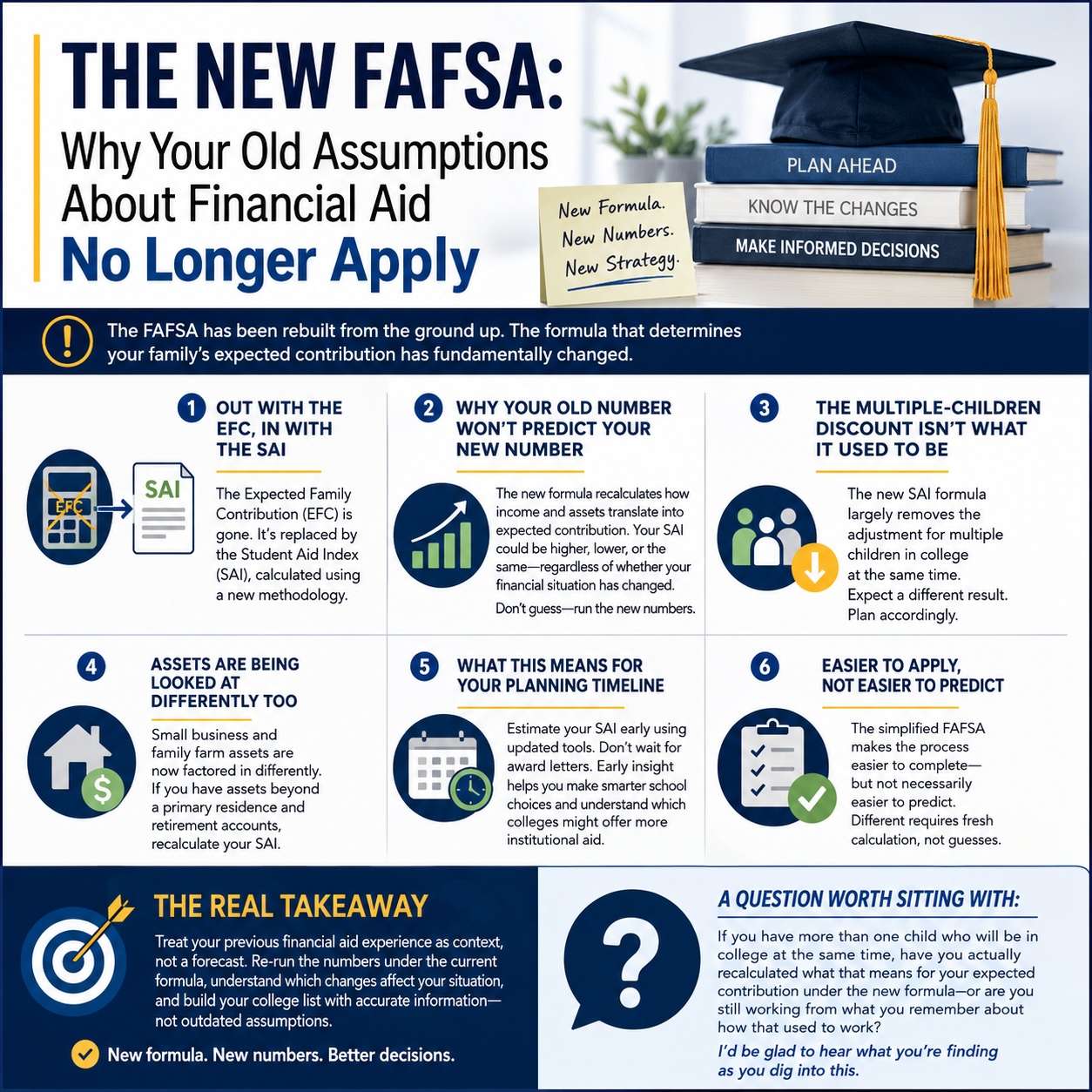
If you helped an older child through the college financial aid process a few years ago, I need to tell you something important: forget most of what you learned. The FAFSA has been rebuilt from the ground up, and the formula that determines how much your family is expected to pay has fundamentally changed.
This isn't a minor tweak. It's a structural overhaul that could shift your family's aid eligibility in ways you won't see coming unless you understand what changed and why.
Out With the EFC, In With the SAI
For decades, families lived and died by the Expected Family Contribution (EFC) — the number that told colleges how much your family should reasonably pay. That number is gone. It's been replaced by the Student Aid Index (SAI).
This isn't just a rebranding exercise. The SAI is calculated using a different methodology, weighing income, assets, and family circumstances in new proportions. Some of the adjustments that used to help families — like discounts for having multiple children in college simultaneously — have been reduced or eliminated entirely. If you have two or three kids in school at once, this is a change you need to understand before you build a budget around old expectations.
Why Your Old Number Won't Predict Your New Number
Here's the mistake I see too often: parents assume that if their financial situation hasn't changed much, their aid eligibility won't change much either. Under the simplified FAFSA, that assumption can be dangerously wrong.
The formula recalculates how income and assets translate into expected contribution. A family that previously qualified for substantial need-based aid might find their SAI comes back higher than their old EFC — not because they earn more, but because the underlying math treats their financial profile differently. Conversely, some families may find they qualify for aid where they didn't before.
The only way to know where you stand is to actually run the numbers under the new system. Guessing based on last year's award letter, or a friend's experience, or what happened with your older child three years ago, is no longer reliable information.
The Multiple-Children Discount Isn't What It Used To Be
This deserves its own section because it catches so many families off guard. Under the old formula, having multiple children enrolled in college at the same time significantly reduced your EFC — the logic being that your resources were stretched across more than one tuition bill.
The new SAI formula largely removes this adjustment. If you're a family with two children heading to college in overlapping years, you cannot assume the aid math will work the same way it did for families in this situation five years ago. This single change has surprised more families than almost any other aspect of FAFSA simplification, and it's one of the most important reasons to re-run your numbers early rather than waiting for award letters to arrive.
Assets Are Being Looked at Differently Too
The way the formula treats certain assets has also shifted. Small business and family farm assets, which used to receive favorable treatment in many cases, are now factored in differently. If your family's financial picture includes assets beyond a primary residence and retirement accounts, this is another area where old assumptions may no longer hold.
None of this means the new system is worse — for some families, it will actually result in more favorable aid outcomes. But "different" is the operative word, and different requires fresh calculation, not extrapolation from the past.
What This Means for Your Planning Timeline
Because the SAI can produce results that diverge from what families expect, the practical implication is this: don't wait until financial aid award letters show up to find out where you stand. By then, you've already made decisions about which schools to encourage your child to apply to, and possibly which ones to rule out based on assumed cost.
Estimating your SAI early — using updated tools that reflect the new formula — gives you the chance to have realistic conversations with your child about school selection before applications are even submitted. It also gives you time to understand which schools might offer better institutional aid to supplement whatever your federal calculation produces, since colleges use the SAI as a starting point, not the final word on your family's cost.
The Real Takeaway
The simplified FAFSA was designed to make the application process easier to complete. It was not necessarily designed to make the outcome easier to predict. Those are two different things, and conflating them is where families run into trouble.
The families who navigate this transition well are the ones who treat their previous experience with financial aid as context, not as a forecast. They re-run the numbers under the current formula, they understand which specific changes affect their situation, and they build their college list with accurate information rather than outdated assumptions.
A question worth sitting with: If you have more than one child who will be in college at the same time, have you actually recalculated what that means for your expected contribution under the new formula — or are you still working from what you remember about how that used to work? I'd be glad to hear what you're finding as you dig into this.